
Local visibility
What do people actually search for when looking for a local business?
Customers are not searching for “a website”. They are searching for businesses, places, information and ways to act. We looked at real Google Search data from Cardiff businesses to see what that means for local owners.
Someone searching for Adam’s Barber Shop might type the business name into Google.
But that is not the only way people found the page.
Some searched for things like:
- barbers Cardiff
- barbers near me
- barber near me
- best barbers Cardiff
The same thing happened with Shawarma Laziz.
Alongside searches for Laziz itself, people found the page after searches such as:
- shawarma near me
- shawarma Cardiff
- city road food
- best shawarma Cardiff
That was one of the most interesting things we found when we looked across the first few months of Google Search data for WeGrow.
Between 8 June and 29 September 2026, pages on trywegrow.com appeared 9,704 times in Google Search and received 240 clicks.
But the total numbers were not really the useful part.
The useful part was understanding what people were actually trying to find.
People are not searching for “a website”
A customer looking for somewhere to get a haircut is unlikely to think:
I need to find a well-designed one-page website.
They are much more likely to think:
I need a barber near me.
Or:
Who cuts hair in Cardiff?
Someone looking for food might be thinking:
Where can I get shawarma near here?
Or:
What food is on City Road?
The website is not the thing they want.
The business is the thing they want.
The website, Google Business Profile, Instagram page, booking platform or other online presence is useful only if it helps them answer the questions between searching and deciding what to do next.
That distinction matters.
Some of the searches were surprisingly broad
For Adam’s Barber Shop, for example, the visible Search Console data included:
- barbers Cardiff — 279 impressions
- barbers near me — 186 impressions
For Shawarma Laziz:
- shawarma near me — 177 impressions
- shawarma Cardiff — 171 impressions
These are not simply people typing the businesses’ names.
They are people searching for a kind of business in a place.
That does not mean everyone who saw one of those results became a customer.
It does not even mean everyone clicked.
But it does show that a useful local-business page can sometimes become part of the search journey for somebody who has not necessarily started with that business in mind.
Location is part of the question
A lot of local-business searches contain some version of:
near me
Cardiff
a neighbourhood
a street or area
That makes sense.
For many local businesses, location is not a minor detail buried in a footer. It is part of whether the business is useful to the person searching.
A barber in Cardiff is useful to someone looking for a barber in Cardiff.
A takeaway on City Road is useful to someone deciding where to eat around City Road.
A physiotherapist, tradesperson or beauty business may instead serve an area rather than expect customers to walk through a particular door.
The exact location information differs by business.
The principle does not:
Make it easy for a customer to understand whether your business is relevant to where they are and what they need.
That might mean an address.
It might mean a service area.
It might mean directions.
Sometimes it means all three.
And in our current Search Console data, around 82% of Google Search clicks came from mobile devices.
That is not a claim about every local business on the internet. It is simply what we are currently seeing across WeGrow.
But it reinforces something fairly intuitive: a lot of local discovery happens while somebody is holding a phone and trying to make a practical decision.
The useful next step is different for every business
One of the things working with Adam’s and Laziz has made very clear is that there is no universal “best contact button”.
For Adam’s Barber Shop, somebody might want to:
- call;
- send a WhatsApp message;
- get directions;
- follow another useful link;
- or check the current offer.
Laziz is different.
It does not take online orders or bookings and does not have a customer phone number to publish.
The useful journey is much more like:
understand what Laziz is → check when it is open → know where it is → go there.
That is why we have become less interested in generic advice like:
Every website needs a contact form.
A better question is:
What is the useful next action for this particular customer and this particular business?
For one business that may be booking.
For another it may be calling.
For another it may simply be finding the front door.
Google Business Profile and a website are not rivals
We have written before about whether a local business needs both a website and a Google Business Profile.
The answer is still not “always”.
Some businesses already have a strong enough combination of Google, Instagram, a booking platform or another online presence.
A website should not exist just so the business can say it has one.
But there is a useful role a website can play.
Google can help someone discover a business.
A website can give the owner a stable place to explain:
- what the business is;
- where it is;
- what it offers;
- the information customers need;
- and the right next action.
Those things can work together.
The mistake is treating the website itself as the customer’s goal.
It is not.
What should a local business owner take from this?
We would not look at this data and tell every local business owner to start researching keywords.
We think the more useful questions are much simpler.
Can somebody immediately understand what you do?
Do not make a new visitor work out what kind of business they have landed on.
Can they tell whether you are relevant to where they are?
That may mean your address, neighbourhood, town or service area.
Can they find the information they need before acting?
For one business that might be opening hours.
For another it could be services, menu information, prices, booking details or directions.
Can they take the right next step without guessing?
Call.
Message.
Book.
Visit.
See the menu.
Get directions.
Whatever genuinely makes sense for that business.
Are those details still correct?
This one sounds obvious until an old opening time, phone number or service detail survives on one profile after it has changed somewhere else.
Useful information stops being useful when it is wrong.
What 9,704 impressions do not tell us
There is an important limit to all of this.
Google Search Console tells us that pages appeared in search results and that some people clicked them.
It does not tell us that 240 clicks became 240 customers.
It does not prove that WeGrow caused a particular ranking.
Adam’s and Laziz already existed as real Cardiff businesses with their own reputation, location, Google presence and local context.
The query report also does not show every search people used.
And two businesses are nowhere near enough evidence to declare that one particular business category is the answer.
What the data gives us is something narrower and, we think, more useful:
Real customers are not necessarily searching for websites. They are searching for businesses, places, information and ways to act.
A useful online presence should make those answers easier to find.
That is the lesson we are taking from the first few months.
Not:
Every local business needs to “do SEO”.
And not:
Every business needs a bigger website.
Something much simpler:
When somebody is looking for a business like yours, make it easy for them to understand who you are, whether you fit what they need, and what they should do next.
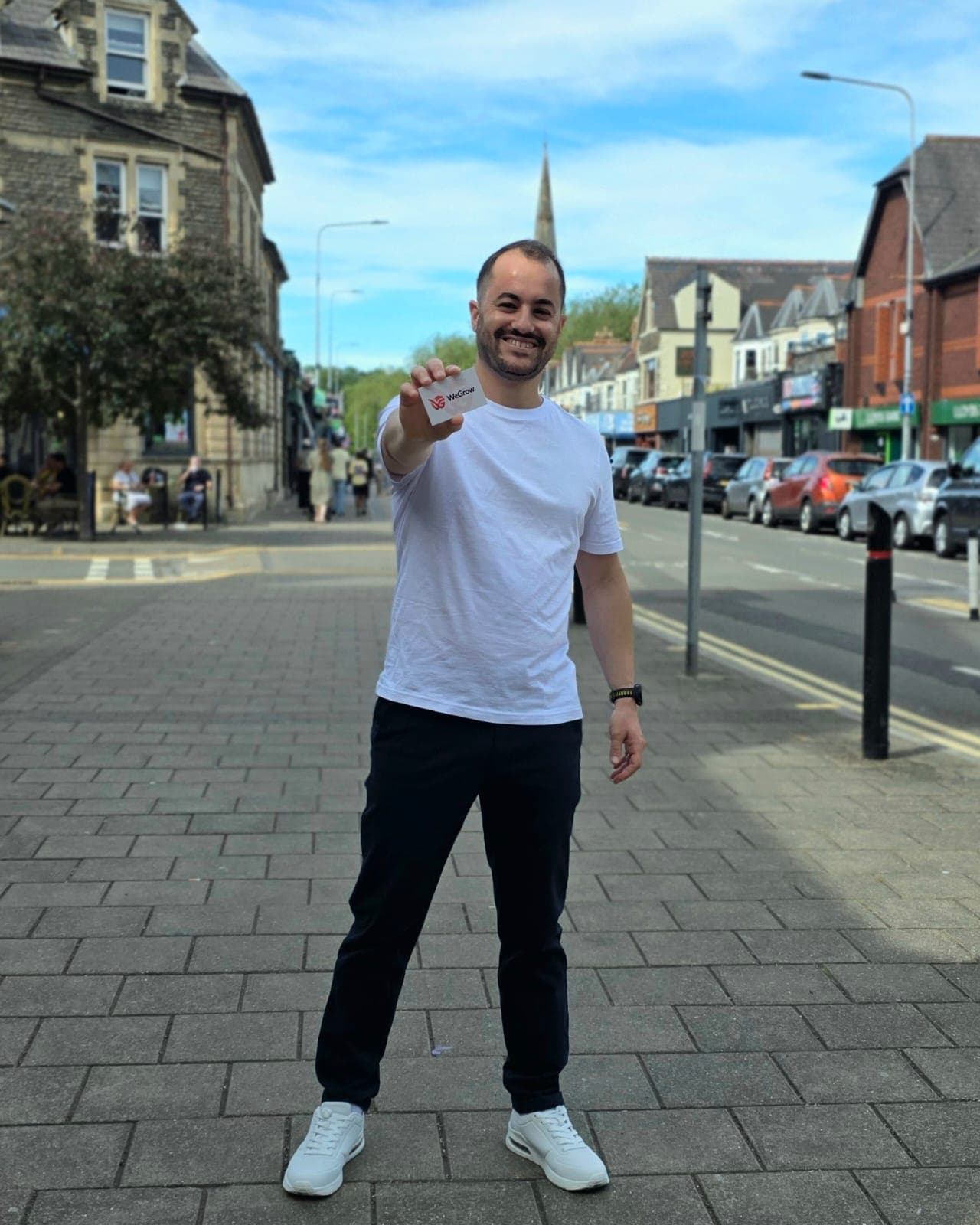
Jad El Omeiri is the founder of WeGrow. He has spent more than twelve years building digital products—from early-stage startups and marketplaces to ecommerce platforms used by millions of people. He now brings that experience into practical, founder-led work with independent businesses in Cardiff and beyond.