
Websites
Does a small local business need a website in 2026?
Good local businesses often already have trust, proof, story, and useful details, but those signals can be scattered across Google, Instagram, reviews, word of mouth, and the physical business. This guide helps owners decide when one clear page is the smallest useful next step.
I built my first website when I was 16.
More than twenty years later, after 12+ years as a professional software engineer, I do not think the interesting question for local businesses is simply: “Do you have a website?”
The better question is:
"Does the online version of your business show what is already true in real life?"
Building WeGrow around real Cardiff businesses has made that question feel much more important.
The real issue is often not whether the business is good. Many local businesses are already good. They already have trust, regular customers, personality, useful details, decent photos, strong reviews, and reasons people choose them.
The problem is that trust, proof, and useful detail are often scattered.
Walking around Cardiff, I keep noticing businesses that feel alive and loved offline, then make a new customer work harder online than they should.
Some of the proof sits in old Google reviews. Some of the story sits in Instagram posts. Some useful details are known by regulars but invisible to new customers. Some things are literally sitting on the counter in the shop, but a normal person looking online would never know.
That is where a simple website, or even one clear owned page, can be useful.
Not to invent value. Not to pretend the business is bigger than it is. Not to turn every independent shop, barber, maker, clinic, or takeaway into a big online brand.
Just to bring what is already true into one place, so the right customer can understand it, trust it, and act on it.
Good in real life, unclear online
A clean online presence does not prove a business is good in real life.
I have seen enough polished websites that say very little to know that. A neat page can still hide a weak offer, poor service, or a business that is not the right fit.
But the opposite problem is the one that bothers me more: businesses that are genuinely good in real life, but unclear online.
That feels like wasted trust.
If a business has earned a good local reputation, the online version should not make a new customer work too hard to see it. If people already love the service, the page should help a stranger understand why. If there are useful reasons to choose the business, those reasons should not be buried in a feed, hidden in old reviews, or only obvious to people who already know where to look.
This is not about making a business look better than it is. It is about making the useful truth easier to see.
What I learned building a page for my barber
Adam's Barber Shop was the first public Presence page I built through WeGrow.
I had been Adam's customer for over a year before building it. I already liked the place. I already trusted the service. I already knew it was a real local business, not just a name on Google.
But while creating the page, I noticed something important: even as a regular customer, I had not properly seen everything that made the business useful.
From the field
Some of the best information was buried inside roughly 130 Google Business Profile reviews. That is valuable proof, but a normal potential customer is not going to read every old review to discover why people keep going back. They might scan the rating, look at a few comments, and move on.
There were loyalty cards physically visible over the counter. I had stood near them many times and still had not really noticed them. For a new customer, that kind of detail can be useful. It tells them there is a reason to come back. It tells them the business is thinking about regulars. On a page, that can be surfaced clearly in a useful details or FAQ section.
There was also a practical contact detail: the Google Business Profile linked one phone number, but there was another number customers could call if the first line was busy. That is not flashy. It is not a marketing campaign. It is just useful.
The website did not create new value for Adam's Barber Shop. It organised and resurfaced value that was already there.
That is a much better reason to build a small local business website than "you need one because it is 2026".
When Google or Instagram may be enough for now
Not every business needs to rush into a website.
Google Business Profile is powerful, especially for local discovery. If someone searches for a cafe nearby, a clinic in Canton, a barber in Cardiff, or a takeaway that is open now, the Google profile may be the first thing they see. Good photos, correct hours, current contact details, reviews, directions, and service information can do a lot.
Instagram can also be brilliant. For some businesses, especially food, beauty, makers, venues, artists, and visual products, Instagram is where the personality lives. It can show what is fresh, what is available, what the business feels like, and whether real people are paying attention.
Marketplaces can be right too. A maker who sells mainly through Etsy may get more value from strong product listings, clear delivery information, and reviews than from building a separate website too early.
So no, the answer is not "every local business needs a website immediately".
Sometimes the next best move is to fix the Google profile. Sometimes it is to tidy the Instagram bio. Sometimes it is to make sure the booking link, menu, opening hours, address, or phone number is actually correct.
A website should not be a guilt purchase. It should solve a real clarity problem.
When an owned page starts to matter
An owned page starts to matter when a customer needs more than one platform can comfortably show.
That might be because important details are spread across reviews, posts, photos, messages, and word of mouth. It might be because your business has a story that does not fit neatly into a Google listing. It might be because customers keep asking the same questions before they feel ready to book, visit, order, or ask for a quote.
I have also spoken with a local shop that has an alright Google Business Profile and relies heavily on Instagram. On the surface, that can look like enough.
Then I discovered they were award-winning.
That sort of discovery has stayed with me, because it was not hidden on purpose. It was just not easy enough for a new person to find.
That kind of proof deserves a proper home. It should not be something only close followers notice, or something a new customer might miss completely. If a shop has earned that level of recognition, it should be clear when someone is deciding whether to visit, buy, or trust them.
Instagram may still be central for that business. I am not anti-Instagram. But not every potential customer is on Instagram, and not every customer wants to piece together a business from posts and highlights. Almost everyone uses the web in some form. Even my late grandmother used the web when she needed something.
Depending on the audience and the business type, relying only on a social platform can leave part of the market underserved.
That is where a website can help: one stable place for the best version of the truth.
What a small local business website actually needs
For most independent businesses, the first useful website is not a large build.
It needs to answer the questions a real customer has before they take the next step:
- what do you do?
- where are you, or what area do you cover?
- who is this for?
- why should someone trust you?
- what should they do next?
The exact details depend on the business.
For a barber, that might mean services, prices or starting points, opening hours, booking or phone details, location, useful photos, reviews, and details for regular customers.
For a takeaway, it might mean opening hours, menu or offer basics, phone number, address, delivery or collection details, directions, and useful links.
For a clinic, it might mean treatments, who provides them, where the clinic is, what happens at the first appointment, accessibility details, and how to book.
For a maker or Etsy-first business, it might mean the story behind the work, product categories, custom-order information, delivery expectations, proof of quality, and links back to the marketplace where buying already works well.
The page does not need to say everything. It needs to say enough.
Enough for a stranger to stop guessing.
Enough for a referral to turn into confidence.
Enough for the business to feel solid before someone visits, books, orders, or asks.
What not to overbuild
There is a temptation to make the first website too big.
You probably do not need a client dashboard, a complicated CMS, accounts, payments, custom animations, a giant blog plan, dozens of service pages, or a system that takes months to finish.
Some businesses will need more later. A larger clinic, a restaurant with online ordering, or a service business with several enquiry routes may eventually need a fuller setup. That is fine.
But a lot of local businesses do not need to jump straight to "full website project". They need the customer journey to be less foggy.
If people already find you through Google, social, referrals, or passing trade, the first job is often to make the next step clearer. Where should they go? What should they know? What should they trust? What should they do next?
Build for that before building for an imaginary future version of the business.
A better decision checklist
Instead of asking "Do I need a website?", ask this:
What is the smallest thing that would make the next customer's decision clearer?
Start with your current online presence:
- If customers already find you on Google, are the hours, phone number, address, services, photos, and links correct?
- If customers mostly come through Instagram or Facebook, can a new person quickly understand what you do, where you are, and how to act?
- If customers come through Etsy or a marketplace, does the profile explain the business clearly enough, not just the products?
- If customers come through referrals, is there one simple link they can be sent after someone says your name?
- If your proof is strong, is it visible without making people dig through old reviews or posts?
- If you have an old website, does it make the business feel as current and trustworthy as it is in real life?
Then choose the smallest useful next step:
- Fix existing channels first if customers already find you there but the basic details are wrong or thin.
- Create a simple owned page if your story, proof, services, useful details, and next step are scattered.
- Consider a professional one-page website if you want the business to feel clearer, more complete, and easier to send people to.
- Wait on a bigger build unless there is a real operational reason for it.
That is the practical decision. Not website or no website. Clearer next step or still too much guessing.
Where WeGrow fits
WeGrow exists because I kept seeing the same gap in real conversations and real pages: good local businesses with more to say than their online presence was showing.
For some businesses, Local is enough: a simple professional business page, free to keep, with direct contact details and the basics in one place. That can be useful for visit-first businesses too, where directions, opening hours, phone number, menu or offer basics, and useful links matter more than a big website.
For businesses that need more room to explain the offer and show proof, Presence is the focused one-page website product with additional sections and customer-action options. It is built around clarity, trust, useful details, and the next step rather than turning the business into a complicated website project.
And sometimes the honest answer is: do not pay for a website yet. Improve your Google Business Profile. Tidy the Instagram bio. Fix the old link. Make the phone number obvious. Put the award, the loyalty card, the useful detail, or the best proof somewhere people can actually see it.
If you are not sure which applies, see what WeGrow could look like for your business before creating an account.
That is the kind of gap WeGrow is here to close, with useful structure and guidance that help owners make the business clearer online.
Because the goal is not to make every small business buy a website.
The goal is to stop good local businesses from being harder to understand online than they are in real life.
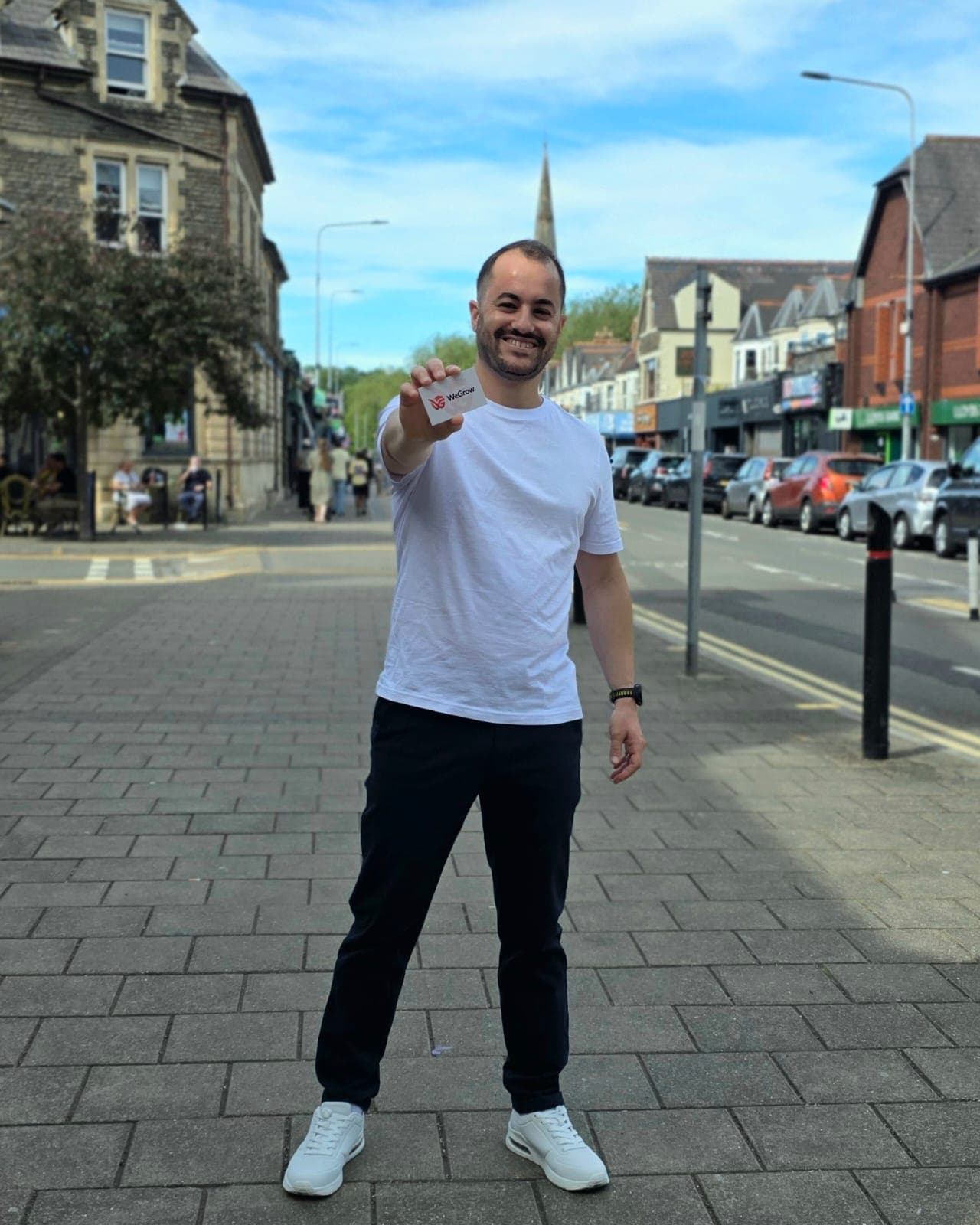
Jad El Omeiri is the founder of WeGrow. He has spent more than twelve years building digital products—from early-stage startups and marketplaces to ecommerce platforms used by millions of people. He now brings that experience into practical, founder-led work with independent businesses in Cardiff and beyond.